CRC: Remote sensing data reveals long-term decrease in US fleet emissions
5 May 2026
The Coordinating Research Council (CRC) released a summary report on real world emission testing campaigns conducted by the University of Denver between 1991 and 2022 [6747]. The research—with financial support from the CRC, the California Air Resources Board and others—utilized remote sensing devices (RSD) that employed optical absorption of IR and UV light by the vehicle’s exhaust plume to record the relative concentrations of emitted pollutants.
The earliest campaigns coincided with the adoption of Tier 1 emissions standards, and the final campaigns were completed about halfway through the Tier 3 phase-in. The resulting database of emissions and ancillary vehicle data provides a valuable historical account of how motor vehicle emissions have changed since enactment of the 1990 Clean Air Act (CAA) Amendments.
The CRC report examines four topics in depth: (1) changes in fleet average emissions with time and location, (2) emissions system deterioration, (3) impact of tailpipe standards on new vehicle emissions, and (4) high emitters.
The analyzed data revealed that the combination of strict emissions standards and aftertreatment technology development that followed from the CAA Amendments proved very effective. RSD data in Figure 1 show exponential declines in fleet average per vehicle exhaust pollutant emissions, with ~2020 CO fleet emissions falling by a factor of 13, HC by 9 and NO a factor of 11 relative to the early 1990s. These declines are consistent across four disparate geographic areas: Chicago, Denver, Tulsa, and West Los Angeles. All three pollutants decrease under Tier 1, but HCs remain flat during Tier 2.
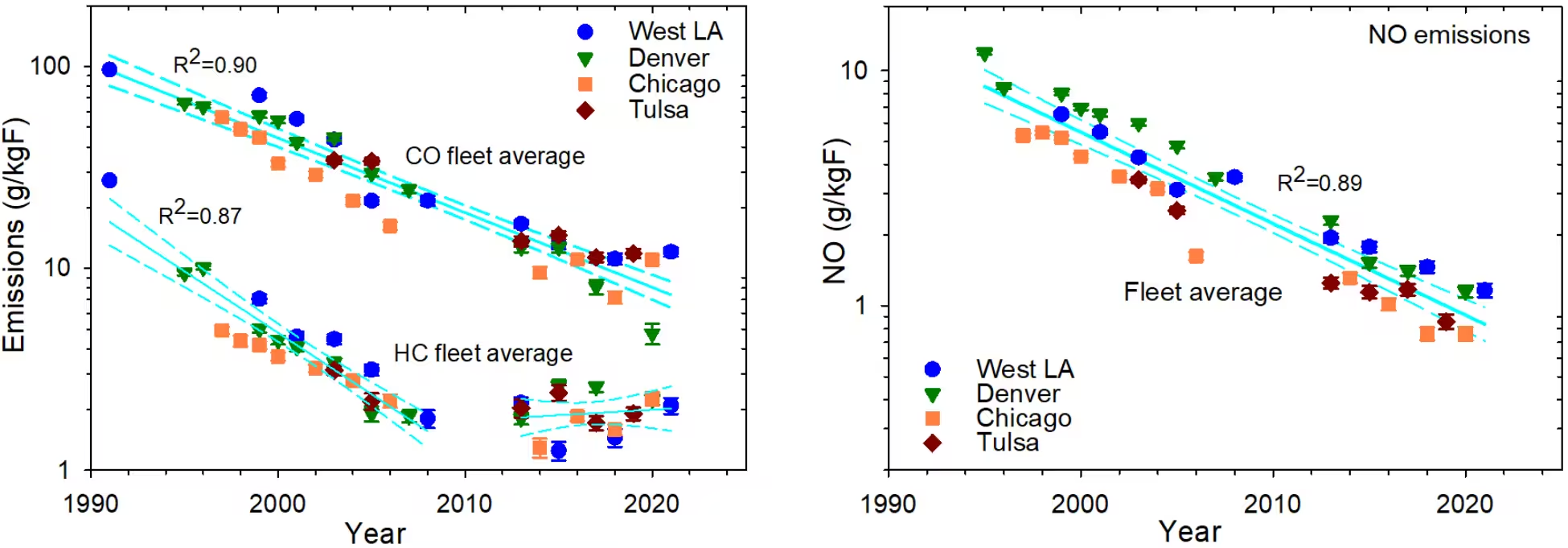
Emission units: grams per kg of fuel. Lines show regressions with 95% confidence intervals.
(Source: CRC [6747])
The data also show some location dependent differences. Over much of the thirty years, Chicago emissions fall below those of the other cities, which was attributed to its younger fleet relative to the other locations. A series of 2021/2022 California campaigns measured CO emissions in Oakland and Stockton at twice the levels in Fresno and West LA likely due to the very high vehicle specific powers, greater than the US06 cycle, at Oakland and 49°C (120°F) temperatures in Stockton.
While inspection and maintenance (I/M) programs were expected to impact the fleet average trends, there is no statistical difference between the non-I/M Tulsa fleet average emissions and those in Denver and West LA subject to long standing I/M programs.
Other key findings of the report are:
- Emissions trends with vehicle age showed an increasing emission durability with increasingly stringent standards, owing to the progressively longer full useful life requirements. For instance, Tier 1 emissions remain below new Tier 0 vehicle levels for twenty years, and Tier 2 levels below new Tier 1 emissions for ten years. This confirms that emissions systems technology advances increased system robustness in addition to substantially lowering emissions levels.
- New vehicle emissions demanded by the standards are decreasing faster than the ability of the fleet to keep pace. Fleet average emissions decline as new technology vehicles penetrate the fleet and old vehicles are discarded. This process takes nearly two decades, with fleet average emissions approaching Tier 1 technology levels as the phase-in to Tier 3 is underway. This implies diminishing marginal improvements from the introduction of new, lower emitting, vehicles. As a result, there is no statistical indication of further improvements halfway through the Tier 3 phase-in.
- The air quality impact of high emitters is increasing, with the top 1% of vehicles contributing 30% of the fleet’s CO and 35% of NO emissions. Removing high emitters from the fleet would be more productive for future emissions reductions than continuing to pursue the declining marginal gains afforded by lowering the standards on already clean new vehicles. I/M programs were conceived as a means to identify and remove or fix high emitters, but the thirty-year history of RSD measurements has shown that I/M programs as implemented have proven ineffective. The methodology exists to identify high emitters, however new ideas are needed to ensure that the identified vehicles receive effective, long term, repairs or are scrapped and to reduce the ease with which engine calibrations can be reflashed to pass the I/M test and then returned to high emitter operation.
Particulate matter measurements were not included in the RSD campaigns due to a lack of a suitable remote sensing technology.
Source: Coordinating Research Council