Horse Powertrain reveals methanol REEV engine
21 July 2026
Horse Powertrain, a global developer of hybrid and combustion powertrains, has revealed its new Horse D20 Methanol range extender powertrain. First shown at Beijing Auto Show 2026, the Horse D20 Methanol is intended for use in range-extended EVs (REEV), where it acts as a reserve power source to recharge a vehicle’s battery.
With a power output of up to 105 kW, the Horse D20 powertrain weighs 170 kg and combines a 2.0 L turbocharged four-cylinder engine with an electric motor and power electronics. The powertrain achieves a 47% fuel-to-energy conversion ratio.
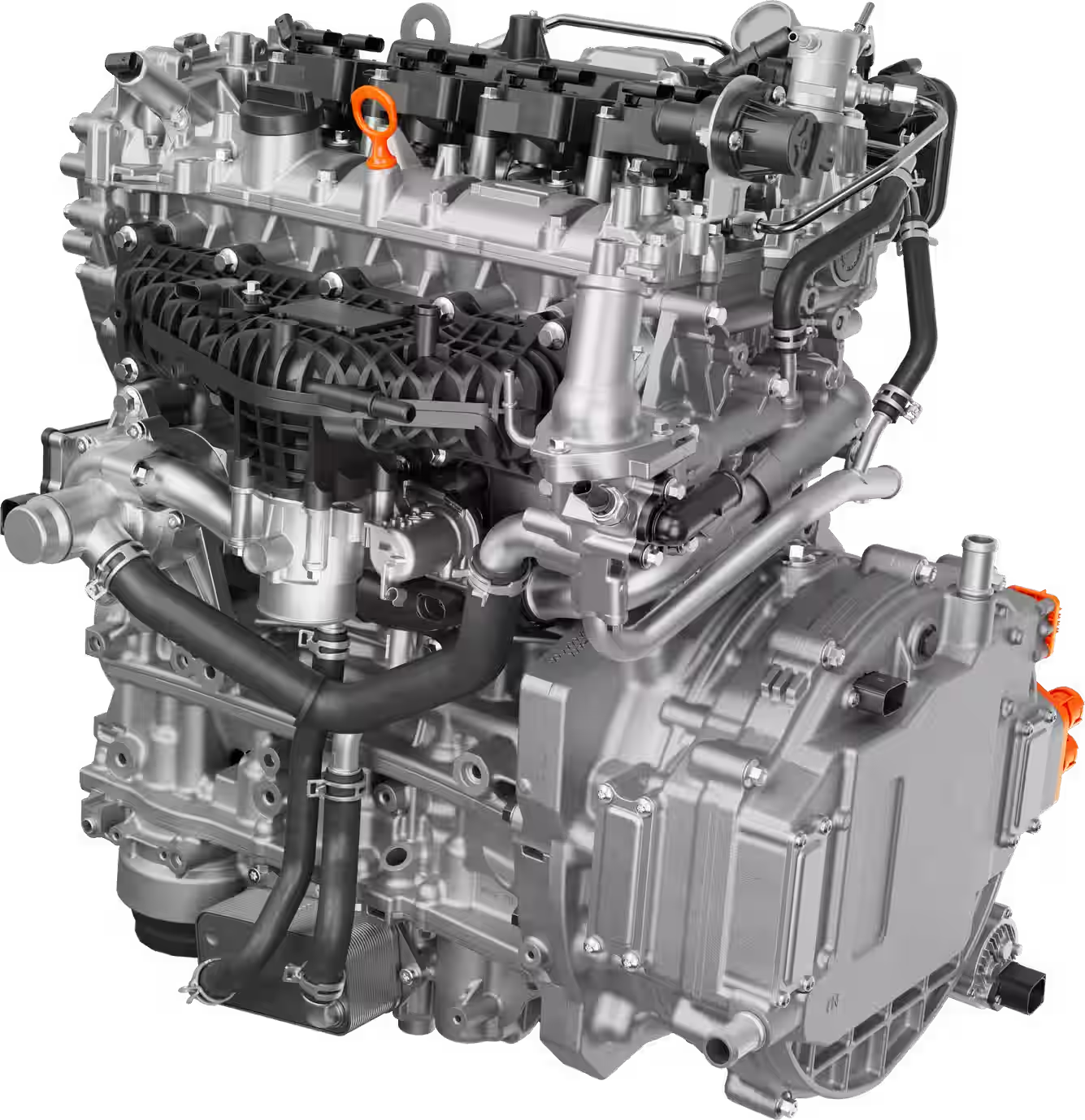
The Horse D20 Methanol’s engine is designed to run off 100% methanol fuel blends. It features a 240 mJ high-energy ignition system to enable ultra-lean burns of methanol in the engine cylinders. The engine is capable of pure-methanol cold starts from temperatures as low as -35°C. The Horse D20 Methanol’s NOx emissions comply with China’s CN6b standard of 35 mg/kWh, and the Euro 7 standard of 60 mg/km.
The powertrain utilizes an all-new generator architecture, in the form of an axial flux motor mounted directly on the engine crankshaft. Unlike traditional radial flux motors, where the rotor typically exists as a cylinder nested within the stator, axial flux architectures layer the rotor and stator as disks stacked atop one another—in the case of the Horse D20 Methanol, its axial flux motor is of a “yokeless” design consisting of two rotors surrounding a single stator.
Compared to a like-for-like radial flux motor, the new axial flux motor on the Horse D20 Methanol is 46% shorter and can output 63% more power per unit of volume. The motor also boasts a high electrical efficiency of 96.4%, utilizing an embedded silicon carbide power module to minimize electrical losses.
According to Horse lab testing results, the powertrain achieves a 47% fuel-to-energy conversion ratio, with 1 kWh of electrical energy produced for every ~2.1 kWh of methanol burned. As a result, the Horse D20 Methanol can fully recharge a 40 kWh EV battery using 19.6 L of fuel.
Source: Horse Powertrain