China ramping up coal-to-gas synthetic natural gas technology
10 August 2026
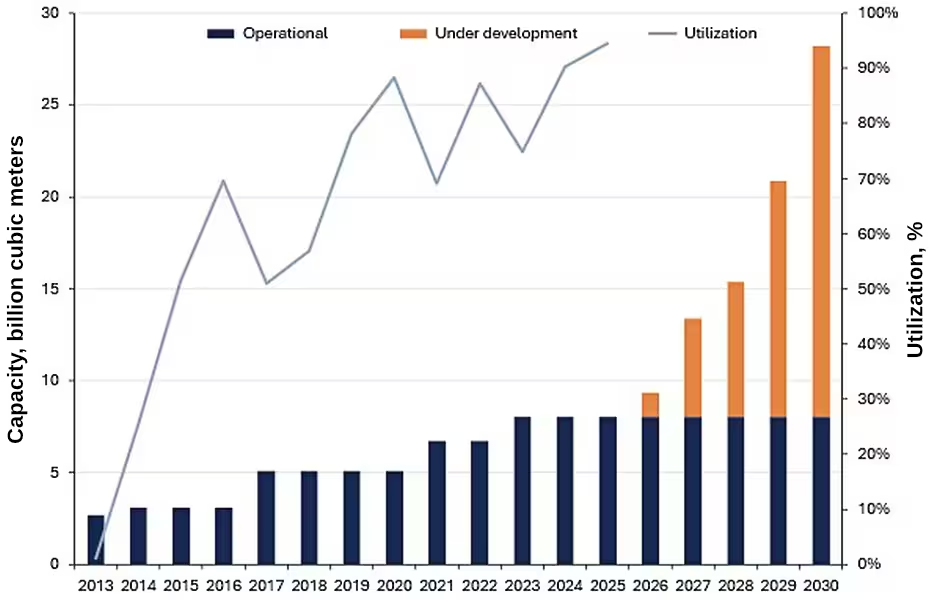
China is building the world’s only large-scale coal-to-gas (CTG) industry as a strategic buffer against energy supply shocks. China’s 15th Five-Year Plan, covering 2026 to 2030, further strengthens CTG’s role in the domestic supply architecture, signaling a move from consideration to active execution. Rystad Energy estimates China’s CTG capacity is on track to reach 9.4 billion cubic meters (bcm) per year by end-2026, growing to 28 bcm per year by 2030.
“China’s coal-to-gas program is a direct expression of its energy security doctrine,” said Wei Xiong, Vice President, Rystad Energy. “In a world where LNG supply chains and pipeline routes are increasingly affected by geopolitics, China is investing in molecules it can produce, store and move without reference to any foreign supplier.”
(Source: Rystad Energy)
China’s remote Xinjiang province has emerged as the hub for CTG expansion, driven by mine-mouth coal prices that averaged just 214 yuan, or $30 per tonne between April 2025 and May 2026, less than 40% of the equivalent price in Inner Mongolia. This cost advantage flows directly into delivered gas prices: Xinjiang CTG reaches East China at $9.1–$9.6 per million BTU, generally below China’s average liquefied natural gas (LNG) import price. Existing plants are running at over 90% utilization, reflecting strong demand and the cost competitiveness of domestic synthetic gas versus imported alternatives. Approximately 20 bcm per year of CTG capacity is currently under development, much of it in Xinjiang.
While the CTG industry remains a supplemental source of natural gas, not a replacement for imports, it has already helped secure China’s supply chains. For example, China produces about 80% of its urea via coal gasification, diverging from the rest of the world which predominantly relies on natural gas. Thanks to the domestic, coal-based urea industry, China largely avoided the fertilizer supply shocks experienced by several countries in the wake of the Persian Gulf war.
The Chinese government, while supporting CTG for energy security, is imposing carbon and environmental requirements on new CTG projects. For instance, the CHN Energy Zhundong development—a 2 bcm per year plant scheduled to begin gas production in 2027—has been designed with electrolytic hydrogen integration, wastewater recycling, and 550,000 tonnes per year of planned carbon capture capacity.
As CTG capacity ramps up, the effect on China’s LNG demand—and therefore on global LNG prices and long-term supply contracting—will become increasingly material for producers from Australia to Qatar to the United States, according to Rystad Energy.
Source: Rystad Energy