US NHTSA resets CAFE fuel economy standards for MY 2022-2031 vehicles
28 September 2026
The US Department of Transportation released the final rule to reset the National Highway Traffic Safety Administration’s (NHTSA) corporate average fuel economy (CAFE) standards. The final rule differs slightly from that proposed in December 2025. The rule establishes fuel economy standards for passenger cars and light trucks for model years 2022 to 2031.
By surveying the measured fuel economy performance of gasoline- and diesel-powered passenger cars and light trucks produced for the U.S. market in MY 2022, NHTSA created a “maximum feasible” foundation from which to establish standards for subsequent model years.
NHTSA is setting fuel economy standards:
- For passenger cars that increase from the newly finalized MY 2022 standards at a rate of 0.90% per year through MY 2029 followed by 1% per year through MY 2031, with MY 2030 stringency acting as a bridge between the vehicle classification updates.
- For non-passenger vehicles, NHTSA is setting fuel economy standards that increase from the newly finalized MY 2022 standards at a rate of 0.51% per year through MY 2029 followed by 1% per year through MY 2031, with MY 2030 stringency acting as a bridge between vehicle classification updates.
- NHTSA estimates that the final standards would correspond to a combined industry fleetwide average of roughly 34.9 mpg in MY 2031 for passenger cars and light trucks.
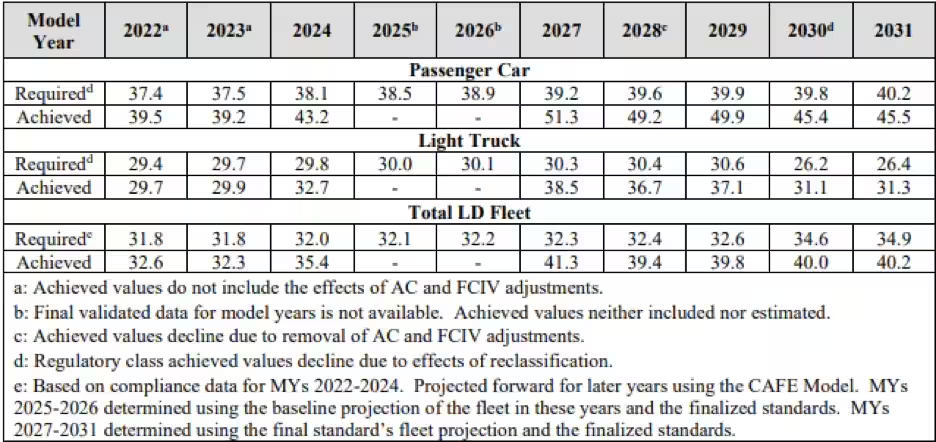
The final rule also changes classification criteria starting in model year 2030 to reflect each vehicle’s intended use, flipping the current fleet mix of approximately 70% light trucks and 30% passenger vehicles to around 70% passenger cars and 30% light trucks. With the current vehicle classification, manufactures are disincentivized from making hatchbacks, wagons, and smaller footprint vehicles.
Significant changes that will take effect with the 2028 model year include the elimination of:
- the CAFE credit trading program which allowed EV manufacturers to sell credits and,
- the ability of manufacturers to claim Air Conditioning (AC) efficiency and Off-Cycle Fuel Consumption Improvement Values (FCIVs) adjustments.
Source: US Department of Transportation