Conference report: SAE COMVEC 2026
15 September 2026
The SAE International’s COMVEC conference was held on September 29 - October 1, 2026, in Schaumburg, Illinois, USA. The formula of the COMVEC forum—the key SAE event that covers commercial vehicle technology—includes keynote speeches and discussion panels rather than technical papers and presentations. The program included 180 panel participants, moderators, and keynote speakers from some 90 organizations. Journal sessions, introduced last year, with presentations based on journal publications have been scaled down and included only 5 papers. The conference also included an exhibition for commercial vehicle manufacturers and their suppliers. The key topic areas this year included digital technologies from machine learning and robotics—described by the marketing term AI—to computer simulation, software defined vehicles (SDV), and automated driving. These new topics attracted a large number of first-time COMVEC participants, as well as several new exhibitors from the software products and services sector. The conference was attended by 645 registered participants.
Several keynote speeches and discussion panels explored the potential benefits of artificial intelligence for the transportation sector. The technology allows for the rapid analysis of vast amounts of data and pattern finding—these attributes can be utilized in product development, manufacturing, and vehicle operation. Legacy product manufacturers spend 40-50 months to develop new products, with some 60% of this time devoted to physical prototyping and testing—AI has a potential to shorten this time [D. Costy, Siemens; SAE Buckendale Lecture]. Many further benefits may be possible, including the reduction of trucks’ downtime and the related costs [O. Panse, KPIT]; intelligent truck systems that will increasingly predict traffic risks; truck connectivity, including vehicle to vehicle (V2V) and vehicle to traffic and facilities (V2X) links; or connected operations of agricultural equipment [E. Shuman, CNH]. These AI technologies, however, significantly increase complexity and come with non-trivial technical challenges. Problems with wider adoption of AI based products also include consumer acceptance—there is low level of public trust in the safety and reliability of AI technologies and consumers tend to avoid complexity and excessive product options or features.
Most of the AI talks were given at a very general level and were not directly related to engine and powertrain technologies. One exception was a presentation by Dumarey [A. Hoth] that discussed the development of a neural network based model for diesel engine calibration. The methodology was driven by engine architecture (a passenger car engine with a variable geometry turbo, water-cooled charge air cooler, dual loop EGR, and common-rail fuel injection) and was not tied to a specific displacement or number of cylinders. The developed neural engine model (dubbed NEMo) could accurately reproduce the physics based engine map with only 1.5 second calculation time. Nonetheless, the benefits of the tool are limited to engine architectures similar to that used to train the model—which is a data driven tool based on pre-existing data from existing design concepts. New concepts that would diverge too much from the original design—for instance, replacing the variable geometry turbocharger with a fixed-vane turbo—would require collecting new data and re-calibrating the model.
While digital technology providers seem to believe that AI can solve the mounting economic and resource problems (one keynote actually mentioned the ‘lunar economy’), a parallel set of ideas has emerged, reinforced by the ongoing energy crisis and its impacts on diesel fuel prices—crude oil is a finite resource and new oil sources that could replace the lost Middle Eastern supplies are more challenging and more costly to extract. Hence, energy efficiency and supply chain resiliency were discussed at several panel sessions, along with the old principles of durability, affordability, profitability, and customer value.
Sources of efficiency gains in modern trucks are not limited to the engine, but include the integrated powertrain and the entire vehicle, with contributions from vehicle aerodynamics and from tires of reduced rolling resistance [R. Radulescu, Michelin]. While US Class 8 heavy-duty trucks historically averaged about 5-6 miles/gallon (mpg), some modern diesel trucks can already double this fuel efficiency. In the 2025 “Run on Less” demonstration by NACFE [M. Roeth], the best diesel truck achieved 11.5 mpg on a real world duty cycle. Manufacturers are striving to further improve powertrain efficiency. International [N. Singh] claimed that their S13 integrated engine, transmission and aftertreatment package can improve fuel economy by up to 15% over its predecessor, while meeting the US 2027 NOx emission standards.
The US and EU energy policy and emission regulations are diverging. The United States has largely abandoned their climate policy and the US EPA has rolled back all GHG emission regulations for engines and vehicles. The agency has also proposed to reverse the prior warranty and useful life periods applicable to model year 2027 and later havy-duty engines, to replace SCR inducement measures such as engine derates with dashboard warnings, and to introduce nonconformance penalties (NCP) that would allow manufacturers to temporarily continue sales of non-compliant medium- and heavy-duty engines. Nevertheless, the 2027 emission limits have not been relaxed and the United States still has the most stringent criteria pollutant regulation in the world [M. Noonan, International]. The lack of regulatory stability (the changes to the 2027 regulation have not yet been finalized) creates further challenges for the industry—a waste of resources, reduced competitiveness, and reduced commonality of the supply chain [A. Yezerets, Cummins].
The commercial truck powertrain technology is becoming more diverse. While the diesel engine is the best option from the total cost of ownership (TCO) perspective and provides the best customer value [G. Braziunas, Daimler], battery electric trucks will likely increase their market share in certain applications (e.g., return-to-base duty). To meet the US 2027 emission standards, the industry is again choosing different technologies [C. Huck, Cummins]. Cummins, Volvo, and Paccar will use electric heater based systems, while Daimler and International will employ light-off SCR catalysts without electric heating. The first technology comes with a fuel economy penalty associated with the heater’s power, the latter with an urea (DEF) consumption penalty. No technical details on either type of aftertreatment system were discussed at the conference.
In the EU, most truck categories must reduce CO2 emissions by 43% on average by 2030—a target that will be challenging to meet [C. Ciaravino, Dumarey][C. Hergart, Paccar]. A mix of diesel and electric trucks would be required, while customers do not want variability in powertrains, electric trucks remain more costly than diesel, and the build-up of charging infrastructure is insufficient to support the required electric truck penetration rate. Chinese truck makers see the EU market as an opportunity, not only for electric trucks, but also for diesel and hydrogen powertrains.
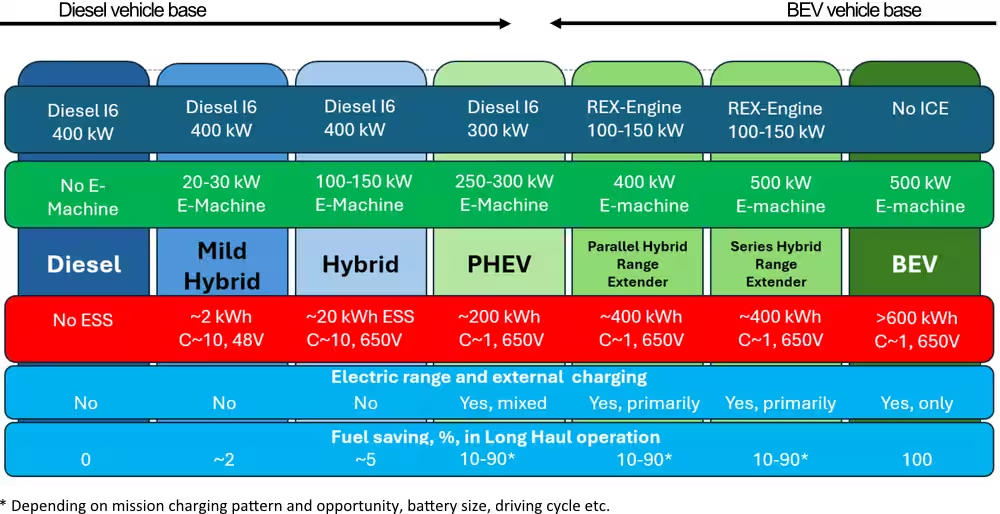
The use of hybrid powertrains in commercial vehicles has been largely limited to light-duty applications, transit buses—where substantial fuel consumption reductions are possible on certain types of routes—and to some vocational applications such as airport rescue and fire fighting vehicles. In long-haul trucks, while various degrees of electrification have been considered, hybrids provide little fuel economy benefit and have not been commercialized. In the absence of consumer demand, future applications are expected to be driven by government policy and regulatory mandates such as those in effect in China and the European Union. For instance, the ZF Traxon 2 heavy-duty hybrid system is about to enter series production in China and the EU.
A panel discussion on automated driving was moderated by Lee White, the Deputy Administrator of the US National Highway Traffic Safety Administration (NHTSA). The agency supports the development of automated trucks and believes the technology has a potential to reduce the number of road traffic fatalities. The panel discussed the ongoing pilot programs of autonomous trucks, as well as off-road robotics applications such as agricultural machinery. Some of the key challenges faced by driverless trucking include safety and the lack of public trust, while the timeline for commercial introduction is still uncertain. In a keynote speech on intelligent transportation systems, Govi Kannan [Mack Trucks] noted that in the aviation sector, the autopilot technology was introduced in the 1950s, but human pilots are flying planes to this day.
The conference also included three panel sessions on heavy-duty trailers, with topics ranging from active control of powered and steered trailers to cybersecurity.
* * *
The next COMVEC conference is scheduled for 14-16 September 2027 at the same venue in Schaumburg, Illinois.