Book review: Variable Compression Systems for Future Engines and Fuels
20 October 2026
Authors: Jean-Pierre Pirault, Philip Dingle, and Martin Flint
Publisher: SAE International
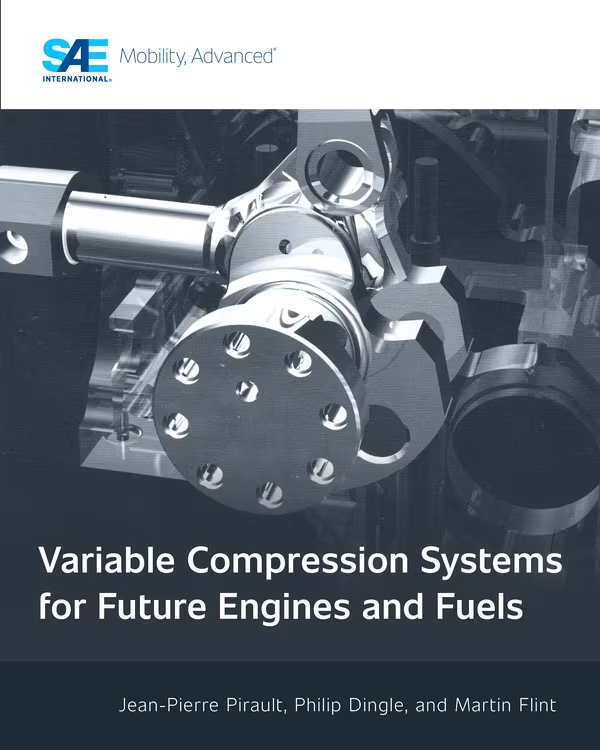 In the ongoing search for internal combustion engine efficiency and carbon reduction, Variable Compression Ratio (VCR) technology remains one of the most promising yet complex frontiers. In Variable Compression Systems for Future Engines and Fuels, authors Jean-Pierre Pirault, Philip Dingle, and Martin Flint deliver a comprehensive, highly technical survey of VCR concepts, analyzing how compression ratio control bridges the gap between conventional architectures and low-carbon, multi-fuel operation.
Architectural Diversity
A significant portion of the book is devoted to categorizing the various VCR mechanisms that have emerged over the past century. The authors break down systems by their structural integration into the engine. Some of the more important technologies are examined in detail with system descriptions and discussions on control strategy and performance. Major categories include:
- Cranktrain & multi-link systems: In-depth discussion of Nissan’s production Multi-Link VCR, VCRi by MCE-5, Ford’s ECCLINK, and Yan Engines’ D-Cycle technology.
- Connecting rod systems: Detailed coverage of FEV’s Two-Step and AVL’s Dual Mode VCR systems.
- Crankshaft modulated eccentricity: The text explores how modulated crankshaft rotational axis eccentricity and modulated crankpin eccentricity can be applied to modern engines.
Additional chapters cover VCR implemented through auxiliary pistons mounted in the cylinder head, movement of the cylinder block relative to the crankshaft and hydraulic and spring mounted piston mechanisms.
Exploring Applications to Modern Engines
The authors offer significant discussion on how VCR could be applied to modern engines with current and future fuels, offering chapters that cover:
- Application to high power engines: Hydraulically actuated mechanisms that move the piston crown relative to the piston pin developed by BICERA (British Internal Combustion Engine Research Association) in the 1950s were further developed by Continental Aviation Engineering (CAE) Corp in the 1960s for military applications. While technically successful, commercial success was elusive. Applying this technology to modern heavy-duty engines could be used to broaden the high BTE island and enable fuel efficiency improvements—especially in applications with frequent load and speed changes.
- Impact on engine systems: New VCR applications for CI and SI engines will need to consider a wide range of impacts on the engine including air charging systems, the combustion system and related chamber geometry, issues associated with fuel injection and fuel–air mixing, thermal loading and heat transfer, the means of CR control, and the general control strategy, including implementation of OBD.
- Advanced combustion engines: For CI engines, VCR is an enabler for LTC, HCCI, and two-zone combustion systems. For SI engines, very high-dilution operation, particularly with cooled EGR, and spark-assisted PPCI combustion can be facilitated.
- CO2 reduction and low emission engines: VCR’s primary contribution to future emission compliance with either current fuels or future low-carbon smokeless fuels is its ability to enable high boosting for high air and/or EGR dilution. Attainment of EU and US 2026/2027 HD exhaust gas emission compliance can be facilitated by VCR technology via lower compression operation, higher air dilution, and faster exhaust warm-up temperatures that give a significantly more rapid catalyst light-off.
- Cost benefit analysis: A favorable cost benefit case can be made for both light- and heavy-duty applications LD and HD applications. Successful application will depend on regulatory requirements that may favor certain powertrains and on the availability of future fuels.
Verdict
Variable Compression Systems for Future Engines and Fuels is an indispensable reference for automotive engineers, powertrain researchers, and academic libraries. Its comprehensive coverage of different VCR design approaches, clear historical context and application to current and future engines make it a definitive benchmark for understanding the mechanical reality and potential of variable compression technology.