IEA releases World Energy Outlook 2026
25 November 2026
The International Energy Agency (IEA) has released its annual World Energy Outlook (WEO-2026) that presents scenario-based analysis of the future global energy system, including conventional and renewable energy. This year, the key focus of the report is on the energy supply shock in the wake of the war in the Persian Gulf.
“The Hormuz crisis has delivered a huge shock to the system. While the energy sector and the global economy have shown considerable resilience, the longer the crisis lasts, the deeper the effects will be. And I don’t see any credible pathway for the energy world to return to the way it was before.”
IEA Executive Director Fatih Birol
The report centers on two main scenarios:
- The Current Policy Scenario (CPS) considers government policies and regulations that are already in place. The CPS scenario is essentially the old Business as Usual (BAU) scenario that the IEA had dropped and then reinstated—yielding to pressure from the US government—in the 2025 edition of the report.
- The Stated Policies Scenario (STEPS) considers a broader range of policies, including those that have been considered or proposed but not yet formally adopted.
Potential additional responses to the energy crisis stemming from the conflict in the Middle East are considered in two further scenarios: the Additional Response Case (ARC) and the Low Hormuz Case (LHC). The Net Zero Emissions by 2050 (NZE) scenario, while still a part of this year’s report, plays a much more limited role than just a few years ago and has been relegated to ancillary chapters.
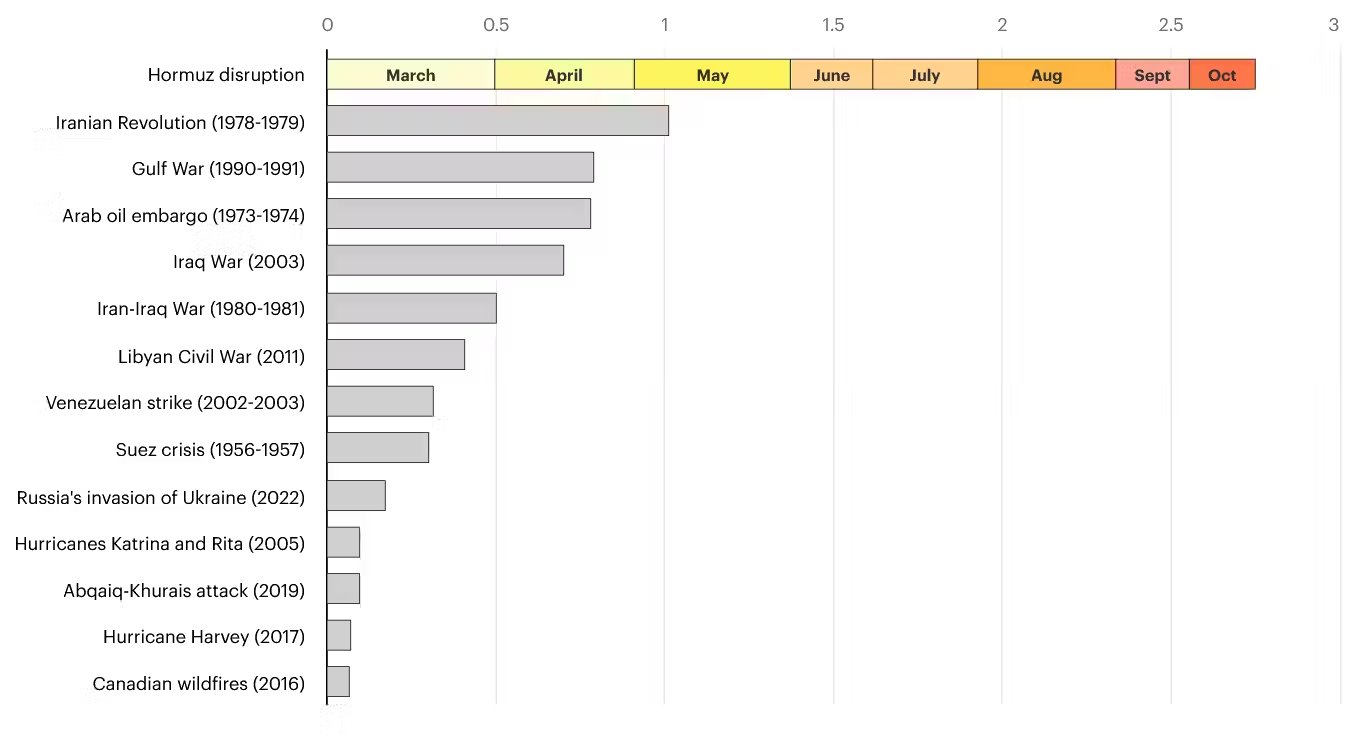
The energy system has shown considerable resilience in the face of cumulative losses of 2.8 billion barrels of oil and 60 billion cubic meters (bcm) of gas supply from the Gulf—the report noted—but increasingly it is falling to consumers and high prices to absorb the impact, as other buffers are run down. Market impacts have been heightened by risks affecting transit through the Red Sea and by disruptions to Russian supply. Supplies of diesel, the workhorse of the global economy, have come under extreme pressure, with prices hitting record levels above USD 200 per barrel.
(Source: WEO-2026)
The IEA report identifies three trends in the global energy market: (1) diversification of fossil fuel supply chains, wherever possible, (2) a focus on indigenous energy sources, both renewable and non-renewable, and (3) a faster transition to electrification.
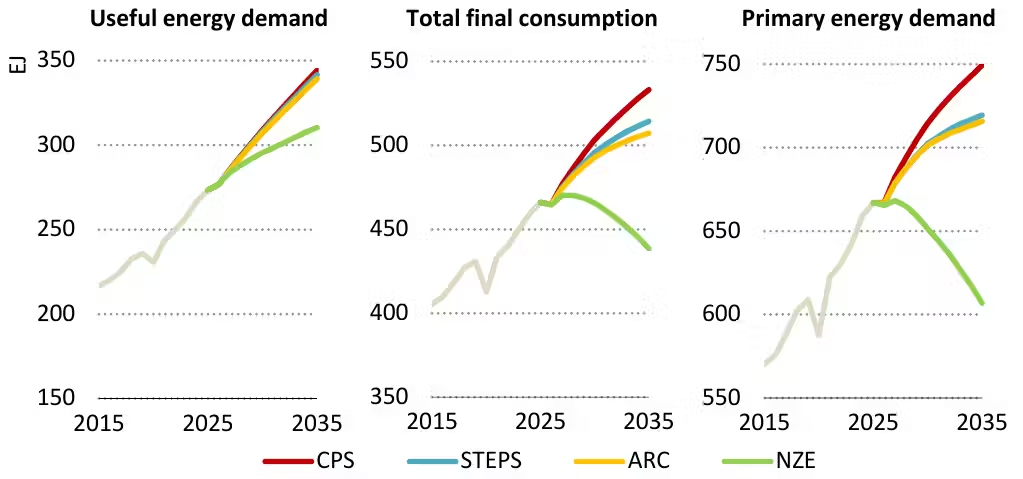
Despite the ongoing energy crisis, the IEA predicts that the global energy consumption will continue to increase. The net energy demand increases under all IEA scenarios, including the NZE scenario. The main difference between the scenarios is that NZE assumes much higher energy efficiency, which results in declining total and primary energy consumption.
(Source: WEO-2026)
It should be noted that the IEA predictions of future energy demand are based on historical trends and current economic models, ignoring the effects of energy and resource barriers on economic and population growth. The CPS, STEPS and NZE all assume the same compound annual growth rates of 0.8% for the global population and 2.2% for GDP per capita from 2025 through 2035.
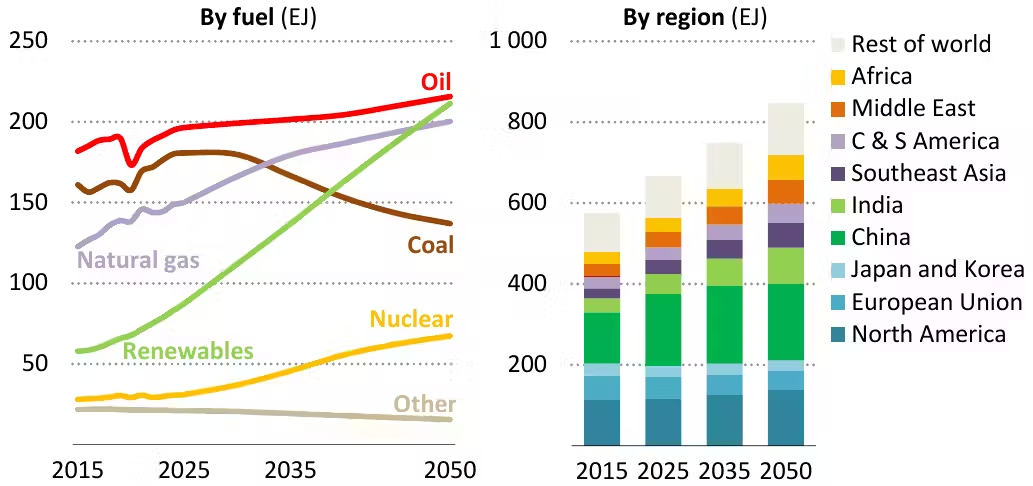
The predicted total energy demand under the CPS scenario is summarized in Figure 3. In this scenario, natural gas and oil consumption continue to grow past 2050. However, the IEA itself seems uncertain about the feasibility of this forecast—the agency discussed the decline of oil and gas fields in a report issued in September 2025. Under the STEPS scenario, oil peaks around 2030 and natural gas reaches a plateau after 2035. Coal stagnates under all scenarios and begins to decline around 2030.
Most of the energy consumption growth occurs in India, Southeast Asia and China. On the other hand, energy consumption is predicted to decline in Europe, Japan, and South Korea.
‘Other’ includes traditional use of biomass and non-renewable waste.
(Source: WEO-2026)
The report predicts a sharp increase of renewable and nuclear energy. Renewables grow rapidly from the current low levels (compared to fossil energy) to almost match oil by 2050, Figure 3. Renewables and nuclear energy grow even faster under the STEPS scenario. However, the report does not discuss the availability of uranium that would be required for the predicted increase in nuclear energy generation.
Demand for electricity grows by more than 10,000 TWh over the next decade, by which time the global electrification rate (the share of electricity in final energy consumption) is closing in on 30% in the CPS and STEPS, up from 23% in 2025. Successful electrification would require sizable investment in copper, transformers, cables and other key pieces of electrical equipment for which supplies are currently tight.
Energy-related CO2 emissions stabilize around today’s levels, below 40 Gt per year, in the CPS but start to decline in other scenarios.
Source: IEA